

In a recent article published in I2D – Information, Données & Documents (2025/2), Véronique Demilly, strategic committee member of TEMS and expert in media technologies at France Télévisions, analyses the structural challenges facing the European media sector and the role data spaces can play in addressing them. Her paper, available to subscribers on Cairn.info, provides a clear and evidence‑based overview of why data governance and shared infrastructures have become essential for the industry. With more than 245,000 companies — 99.8% of them SMEs — and over 1.32 million employees, the sector is both economically significant and highly fragmented. This fragmentation limits the ability of individual organisations to collect, analyse and leverage data at scale, while global digital platforms dominate thanks to their capacity to gather and process vast volumes of user data.
In this context, data has become a decisive factor for competitiveness. Audience insights, usage data, descriptive metadata, rights information and verification data are now essential to remain visible, relevant and capable of engaging younger audiences. The emergence of generative AI further amplifies the urgency: according to the study cited in the article, the music and audiovisual industries could face a loss of more than 20% of revenues by 2028 due to AI‑generated content. Ensuring fair remuneration for creators and maintaining the integrity of European works requires new technological and governance frameworks. As the article notes, without robust data foundations, media organisations cannot fully benefit from AI or protect their value.
Data spaces offer a structural response to these challenges. Defined as sovereign, trusted and interoperable environments for data sharing, they enable collaboration while respecting European values and rules. By breaking down silos, they allow media organisations to combine datasets, improve audience understanding, enhance discoverability, and support fair compensation for rights holders. The European Commission’s data strategy has made sectoral data spaces a priority, recognising their potential to strengthen competitiveness and innovation across industries.
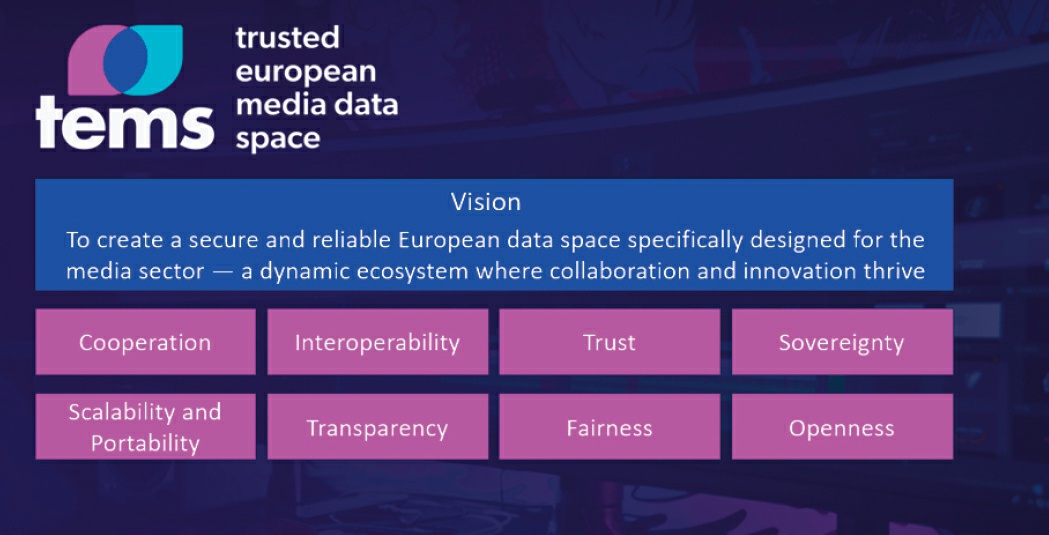
TEMS — the Trusted European Media Data Space — is the concrete implementation of this vision for the media sector. Backed by a €16 million project, 42 partners from 12 countries and €8 million in EU funding, TEMS aims to deliver solutions that are easy to use, durable and interoperable. Alongside the infrastructure, the project develops practical use cases such as TAMIS, which improves the quality and circulation of audiovisual metadata, and initiatives enabling creators to provide training data for AI models with fair remuneration. Additional use cases span news, fact‑checking, targeted advertising, audience analytics and accessibility assets. A non‑profit governance structure will ensure transparency, sector-wide representation and long-term sustainability, with the first legal entity planned for 2026 and commercial opening expected by the end of this same year.
.