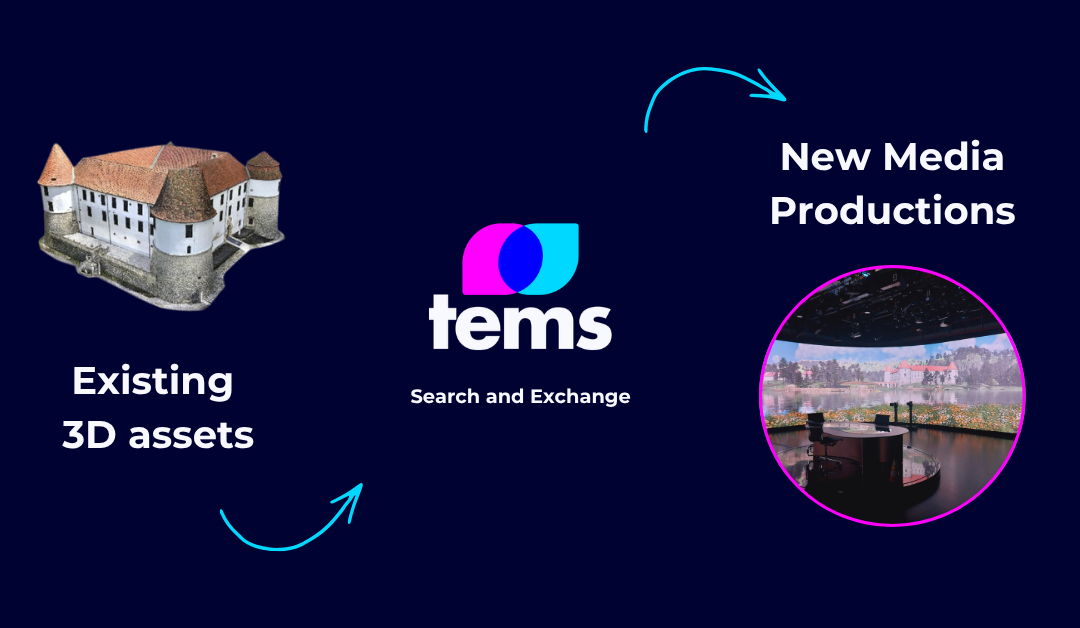

On March 24, we gathered online for the TEMS workshop Reusing 3D heritage models in media. To explore the future of 3D heritage in media, the workshop was organised to introduce and test the concept of the TEMS 3D Marketplace. Why this matters is clear: cultural heritage assets hold great potential for storytelling, education, and innovation. But how might they be reused in innovative media productions? And what barriers and challenges are there? During this workshop, we set out to find the answers.
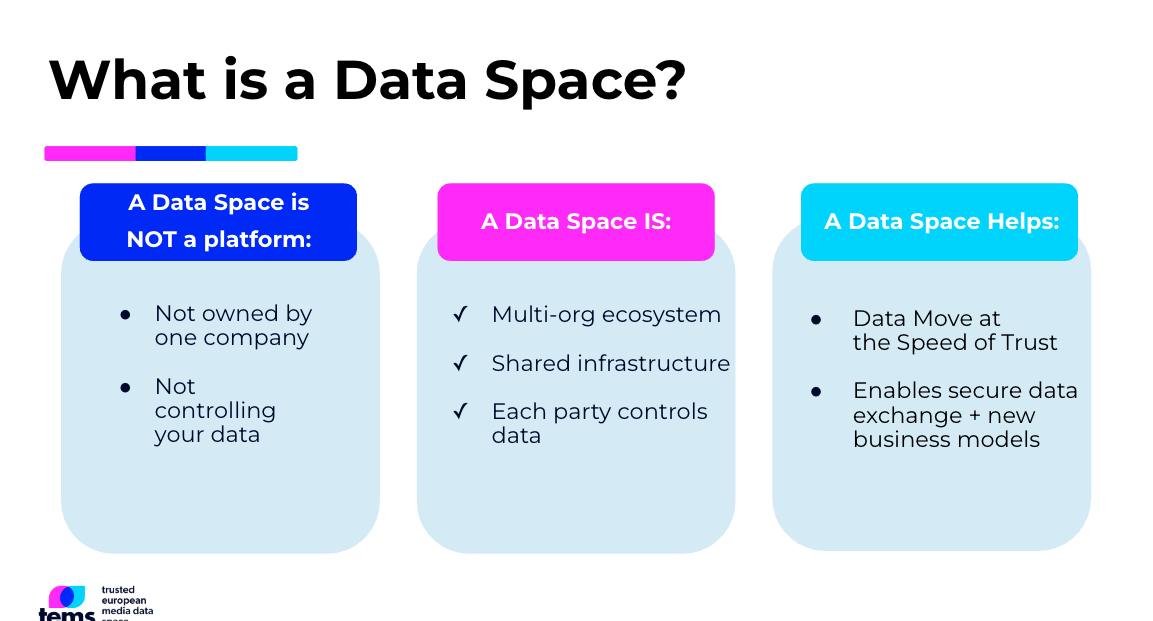
As it cannot be expected that all participants understand what a data space is, we kicked off the workshop by explaining what a data space is, also covering what it is not. A data space is not a platform, owned by one country, controlling all data. Rather, it is a multi-organisation shared infrastructure where each participant can control their own data and control how it is being reused in cross-sectoral collaboration. It enables secure data exchange and new business models. TEMS enables this exchange among many use cases, of which the 3D marketplace is one. The TEMS 3D marketplace aims to increase the reuse of 3D heritage models across media production, moving away from one-off assets into reusable products.
But how might media production companies make use of these models? And what barriers are there for heritage institutions to share their assets? After the introduction to TEMS, we zoomed in on the two main users of the marketplace and their needs, wishes, challenges and barriers.
1. Demand
VRT presented how virtual productions might make use of 3D heritage assets in new, innovative ways. But why does cultural heritage matter in the media you might ask? Well, for several reasons:
- Using actual heritage materials adds to authenticity and depth to storytelling;
- It enables historically accurate environments;
- It has strong educational and societal value;
- And it connects audiences to shared European culture.
Beyond virtual sets based on real locations, heritage assets can for instance be used in the production of historical documentaries and reconstructions, educational and interactive formats and in immersive storytelling through eXtended Reality (XR).
This all might sound like a big win for media companies, however there are still some difficulties today in realising media productions with 3D heritage models. Heritage data is often difficult to find and not production-ready, resulting in complex and more importantly manual processing procedures. This means costs get high very quickly and time investments are high.
This is where TEMS steps in. Through the trusted media dataspace, cultural heritage assets become discoverable across organisations, enabling easier reuse of 3D content in media production and bridging media workflows. In addition, TEMS partners up with initiatives like 3D-4CH – the Online Competence Centre in 3D for Cultural Heritage – ensuring easier production processes and more accessible formats for creators.
2. Supply
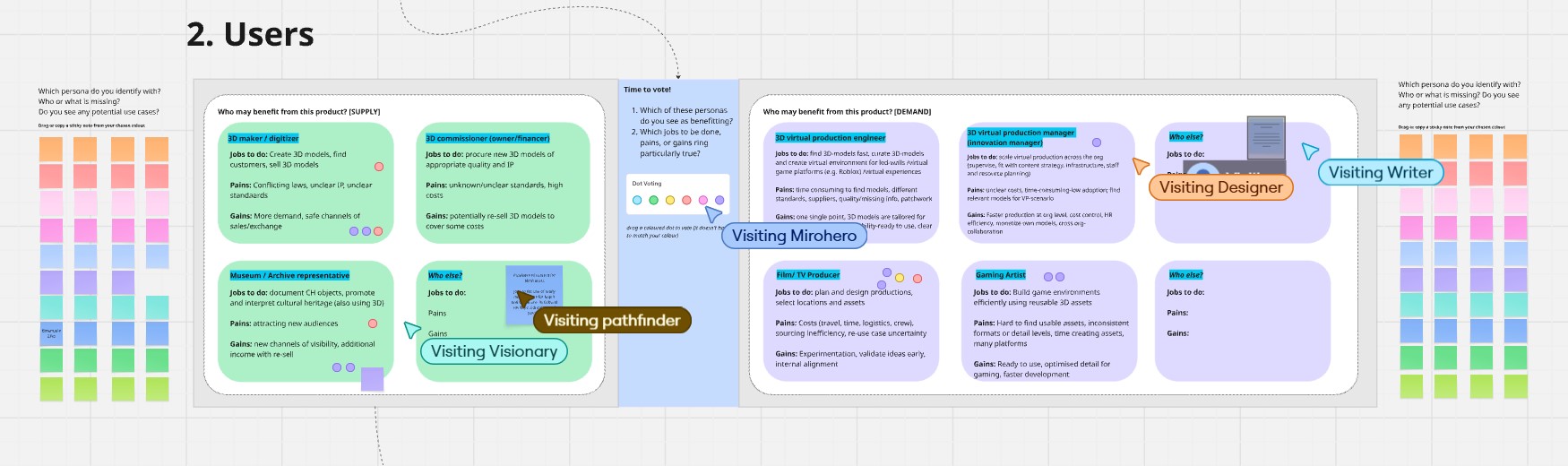
Next, ARCTUR zoomed in on the supply side of the TEMS marketplace; who could actually supply their 3D models through the dataspace? Three categories of suppliers can be identified:
- Museums and archives;
- Digitisation companies;
- Independent digital archeologists and citizen scientists.
Heritage organisations are more and more partnering up with digitisation companies, digitizing their collections for future preservation. However, beyond preservation, these assets can also play a big role in media productions, stimulating engagement. Reasons for museums and archives to make their collections available for media productions might include revenue from licensing, visibility and increasing institutional reach, and of course facilitating research.
However, as for the demand side, there are also some barriers and concerns for suppliers. Questions arise related to IP rights and ownership: Who owns the rights to a digital copy of a 2000 year-old public monument? In addition, heritage institutions often worry about contextual stripping – what if a 3D model is used without its true, authentic place in history?
When we talk about supply-side barriers, we often assume it’s a hardware problem. It’s not. It’s a trust problem. Museums are the ‘custodians of history,’ and their primary fear is that a marketplace will turn them into ‘content libraries.” That’s why the TEMS marketplace will focus on trust, governance, sovereignty and more, ensuring that the owners of 3D assets stay in control of what happens with their assets and can set their own set of rules and regulations.
3. Interactive part
After the two presentations, it was time for the interactive part of the workshop. In break-out rooms, participants were given the chance to play around with the prototype of the TEMS 3D marketplace, provide their feedback and identify potential users on both the demand and supply side. Discussing business viability was the goal: under what conditions would they participate in TEMS and how can TEMS ensure trust and control?
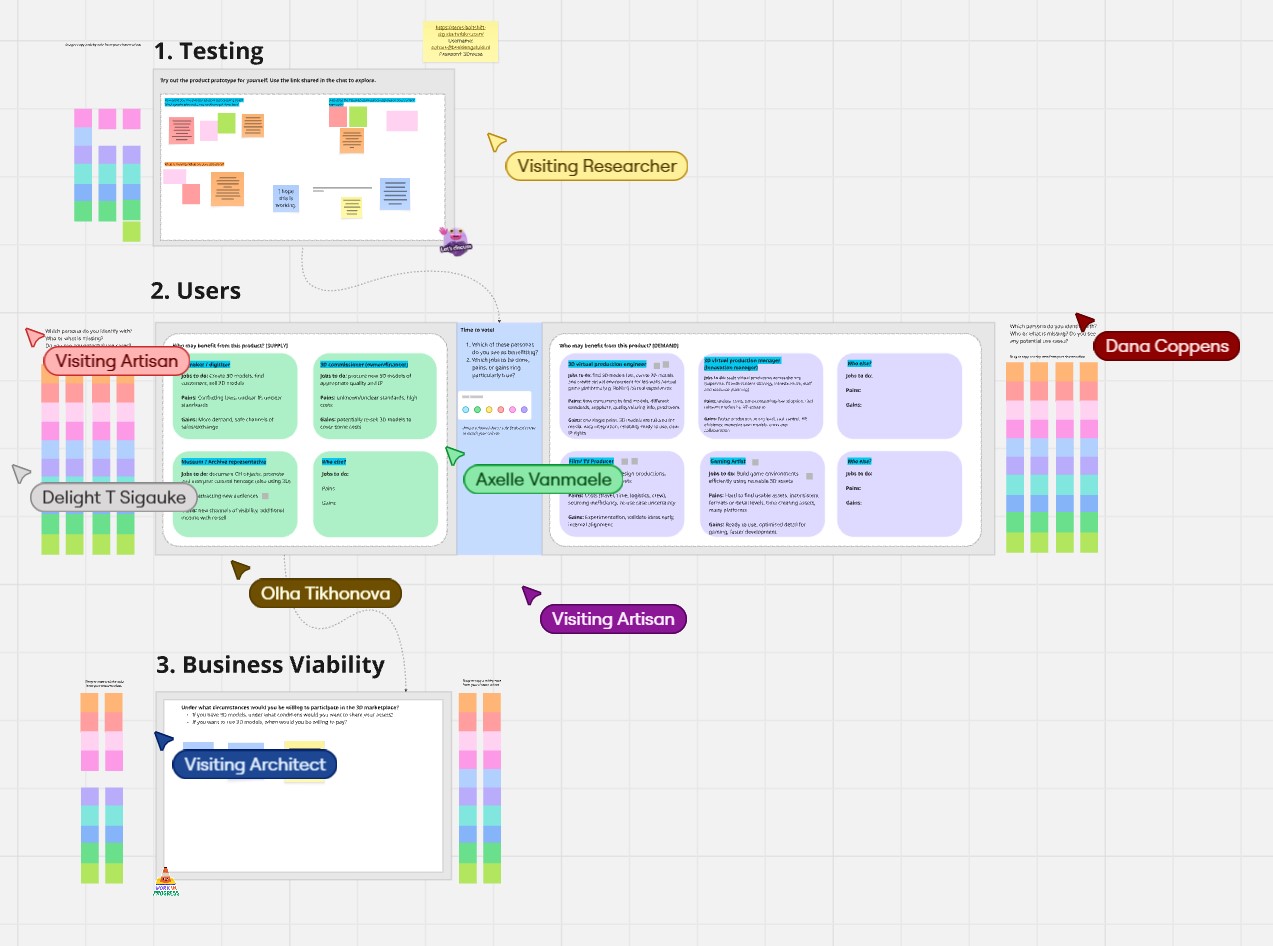
The input from the participants provided us with the following valuable insights:
- The workshop confirmed that the challenge is not just optimizing an existing service, but creating a new market and ecosystem for 3D asset reuse.
- The core value lies in providing trusted, ready-to-use 3D assets that can be easily integrated into production workflows.
- The strongest willingness-to-pay signal is conditional on assets being directly usable and ready-to-integrate.
- Time and cost-saving are the main drivers from the demand side, envisioning time being saved in the workflow
- Trust is a key value: TEMS must go beyond a standard market place, offering IP clarity, usage control, and preservation of context. This is essential for the supply side, especially for cultural heritage institutions providing 3D heritage models.
- The initial core market for TEMS must be broadcasting and media in general providing assets for virtual productions. Gaming follows shortly after, as they require a different product approach.
Some barriers for adoption were also identified and key for TEMS to consider moving forward:
- Usability and Integration: Usability and workflow complexity (including navigation and discoverability) are greater barriers to adoption than access to the assets themselves. Users want usable, context-specific assets, not just “more assets”.
- Technical Fragmentation: There is a strong need for multiple versions of assets depending on the use case (e.g., high-detail vs. optimized) because a single asset format is insufficient.
- Supply-Side Challenges: Cultural heritage actors are critical suppliers, but they require significant support, including education, guidelines, and templates, to address issues like licensing complexity and a lack of commercial mindset.
Conclusions and moving forward
The workshop confirmed the necessity of a trusted marketplace like TEMS to ensure trusted ready-to-use 3D assets. To succeed in this, TEMS must differentiate itself by becoming a workflow enabler:
- Beyond a Catalogue: TEMS must move beyond being a mere “catalogue” to become a workflow enabler, a trusted exchange layer, and a service + asset ecosystem.
- Focus on Existing Supply: A large amount of 3D content already exists in cultural heritage institutions and archives but is inaccessible. TEMS should focus on unlocking and activating this existing supply rather than only creating new content.
- Priorities: Immediate priority areas include improving UX and discoverability, ensuring clear licensing/IP frameworks, and enabling direct integration into production pipelines.