|
| TEMS Newsletter #9 |
| TEMS - which stands for Trusted European Media data Space - is a joint undertaking of 42 organisations representing hundreds of stakeholders from 12 countries in the cultural and creative sectors. TEMS is the flagship European initiative to build a resilient data-driven ecosystem in the media sector. |

|
| The Untapped Data Goldmine of Europe's Creative Industries |
| TEMS is here to speed up the digital transformation, boost competitiveness of the European media landscape and establish new alliances between media companies to access and manage data in order to fight big tech. While much of the discussion around media data naturally focuses on broadcasters, news agencies, and audiovisual producers, many other sectors are exploring how they can benefit from a trusted data sharing ecosystem too. Among them are the Cultural and Creative Industries (CCIs), including heritage institutions, performing arts organizations, gaming companies, and many others. |
| Over the past year, TEMS organized a series of events inviting stakeholders from these CCI subsectors to discover the possibilities of data sharing, explore innovative use cases, and contribute their perspectives on the future of Europe's media data space. From speculative design sessions and workshops to discussions on legal frameworks and trust, these events sparked new ideas and valuable conversations. Here's what we learned. |
| Cross-pollination with Media Data |
| CCIs generate enormous amounts of valuable data every day. From content like the lyrics of a song, a novel, a film script, and a museum collection to viewing statistics, audience engagement metrics, ticket sales, listening habits, and gaming behaviors. All of these are forms of data that, when connected and analyzed responsibly, can reveal powerful insights. |
| What if creators could better understand why certain stories resonate with audiences? What if publishers, game studios, and broadcasters could identify emerging cultural trends before they become mainstream? What if organizations could build stronger relationships with their audiences based on evidence rather than assumptions? |
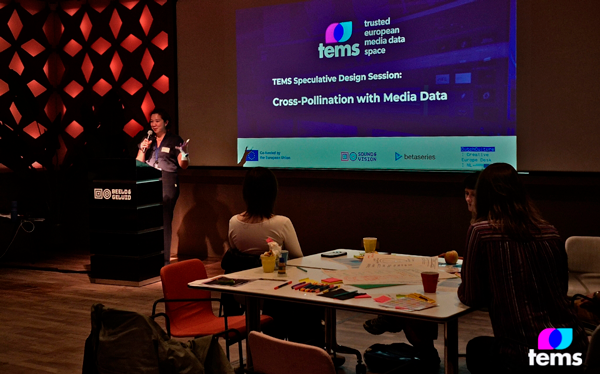
| These questions formed the starting point of the TEMS Speculative Design Session Cross-pollination with Media Data, organized in the autumn of 2025. Bringing together participants from different sectors, the workshop challenged attendees to imagine what could become possible if this wealth of data was shared through TEMS. Working in multidisciplinary teams, participants developed innovative concepts, tools, and business models designed to unlock new value from shared data. |
| The results: five prototype concepts that demonstrated how data could support creativity, innovation, and collaboration across sectors. One concept focused on emerging trends in virtual reality, proposing an interactive platform where producers, designers, and creative studios could exchange insights, share 3D models, and learn from best practices. Another challenged the dominance of recommendation algorithms by introducing user-controlled digital personas. Rather than relying on big tech algorithms, individuals would create and manage profiles reflecting their media preferences, enabling personalized recommendations across cultural sectors while maintaining greater control over their own data. |
| The session highlighted a common theme: data sharing is not merely about technology. It is about creating new ways for organizations and audiences to connect, collaborate, and create value together. |
|
|
|
| Reusing 3D heritage models in media |
| The conversation continued in spring 2026, when TEMS turned its attention to one of the most exciting intersections between culture and technology: 3D heritage models and virtual production. Across Europe, museums, archives, and heritage institutions are increasingly digitizing collections through advanced 3D scanning technologies. These digital replicas help preserve fragile artifacts, protect cultural heritage from physical deterioration, and make collections accessible to broader audiences. But preservation is only part of the story. The real opportunity lies in reuse. How can these digital assets become building blocks for entirely new forms of storytelling with cultural heritage? |
| During a series of workshops focused on heritage and virtual production, participants explored how 3D models could be integrated into media productions across sectors. Broadcasters examined how virtual environments could enrich television formats. Game developers discussed opportunities to incorporate historically accurate assets into immersive experiences. Participants also explored potential applications for journalism, education, and interactive storytelling. The discussions helped shape the Market and co-creation place for 3D environments for virtual production, where organizations will be able to discover, exchange, and collaborate around 3D assets and virtual production resources. |
| At the same time, it became clear that many organizations were still searching for concrete examples of how immersive storytelling could work in practice. To bridge that gap, TEMS joined forces with the European project 3D-4CH, an online competence center supporting the digital transformation of the cultural heritage sector. Together, they organized the co-creation session Storytelling in XR (eXtended Reality). |
| Participants were guided through the complete creative process of designing immersive experiences, from initial concept development to building engaging interactive narratives. The session demonstrated how cultural heritage assets can move beyond preservation and become active ingredients in innovative storytelling experiences that engage audiences in entirely new ways. |
|
|
| Building Trust: Your Data, Your Rules |
| While enthusiasm for data sharing was high throughout the events, participants consistently raised an equally important topic: trust. Questions about intellectual property, ownership, context, and control surfaced during every discussion. What happens when data leaves my organization? How can I ensure it is used appropriately? How do I maintain control over sensitive information? And how can data sharing be reconciled with evolving European regulations? These concerns are not obstacles to data sharing, they are prerequisites for making it work. |
| To address them, TEMS organized the webinar Your Data, Your Rules: Legal Tools for Building Trust in Data Sharing. The webinar explored how organizations can participate in data spaces while retaining full control over their information. Our legal experts introduced practical tools that are currently being developed within TEMS, including the shared Rulebook, which establishes common rules for participation, and the Policy Library, which enables organizations to define permissions, restrictions, and conditions for data use. Participants also learned about the Register of Transactions, which provides transparency, traceability, and observability throughout the data-sharing process. |
| The webinar concluded with an interactive Q&A session. Below are some of the key questions discussed: |
| How do you ensure that organisations remain in control of how their data is used? |
| Data sharing within TEMS is governed by contracts agreed upon between the data supplier and the data consumer. Participants can use standard contract templates provided by the data space and adapt them to their specific needs while adhering to the core rules and principles of the ecosystem. Contract terms can be tailored to address aspects such as data access rights, geographic restrictions, duration of use, pricing models, and permitted AI applications. |
| How do you plan to ensure that media works can be precisely identified through a unique identifier? |
| TEMS will use a registry to identify participants and enable the traceability of datasets and their usage. Media works can be linked to unique identifiers, which may exist independently of the data space, while datasets exchanged within TEMS will also have their own identifiers. To ensure transparency and accountability, every data exchange will be associated with a contract agreed upon by the participating parties, creating a clear record of how data is shared and used. |
| Are the documents discussed during the webinar, such as the Rulebook, publicly available? |
| Not yet. As TEMS is still an active project under development, many of the legal tools, templates, and governance documents are currently being finalised. Once the data space goes live, these resources will be made publicly available through the TEMS website. In the meantime, interested stakeholders can consult the Sitra Rulebook for a Fair Data Economy, which serves as the foundation for the TEMS Rulebook. |
| How do you ensure the quality of the data shared through TEMS? |
| As part of the registration process, participants will be verified to ensure they are active within the media sector and can demonstrate a relevant professional role. This helps maintain a trusted environment and supports the quality and reliability of the data shared through the platform. At the same time, TEMS aims to remain as open and inclusive as possible, balancing accessibility with quality assurance. |
| In case you missed the webinar, the recording of the session is available on the TEMS website: |
|
|
| Looking Ahead |
| The Cultural and Creative Industries have demonstrated that they are not peripheral actors in Europe's media data ecosystem. They are essential contributors whose knowledge, creativity, and data assets can help shape its future. As TEMS continues to develop its data space, the project will organize more events designed to help organizations discover how data can support innovation, collaboration, and growth. |
| Keep an eye on the TEMS website and follow us on LinkedIn to stay informed about upcoming events, new opportunities, and the next chapter in Europe's media data journey. |
