
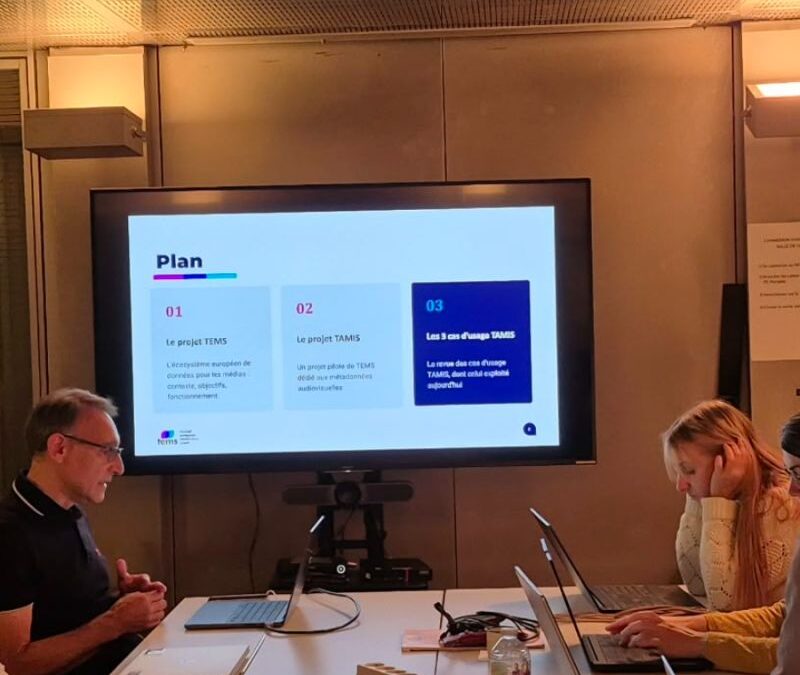

On 10 September 2026, the INAthèque Lab and the Netherlands Institute for Sound & Vision co-organised a workshop in Paris, dedicated to discovering and exploring INA’s broadcasting data, enriched through ISAN’s contribution to the TAMIS pilot project.
Held as part of the European TEMS project, the workshop brought together students, researchers and professionals working in the media and social sciences. Its purpose was to demonstrate how sharing, exploring and enriching audiovisual data can support the study of audiovisual works, professional collaborations and broadcasting strategies.
Enriched data for a better understanding of how audiovisual works circulate
Régis Flad, Managing Director of ISAN International Agency, presented the TEMS and TAMIS projects, as well as ISAN’s contribution to enriching audiovisual data. His presentation helped participants better understand the sharing of audiovisual metadata and its potential applications. Drawing on the work conducted by INA, ISAN and PROCIREP within the TAMIS proof of concept, he provided a concrete illustration of how a data space operates.
ISAN’s contribution was directly integrated into the dataset used during the workshop. The dataset covered one month of broadcasts, in September 2024, across twelve French television channels. Before the workshop, INA’s descriptive data had been enriched with ISAN identifiers to improve the identification of audiovisual works and connect them with their various broadcasts.
This process made it possible to link information about the audiovisual works with their presence on air and to assess the importance of repeat broadcasting on French television. For the most frequently repeated series, the same episode could be broadcast up to three times during the period studied.
For INA, the workshop also provided an opportunity to introduce these data to people who may use them in their own research. The discussions addressed topics ranging from media economics and the sociology of culture to the organisation of work in the audiovisual sector.
Revealing professional networks
The practical part of the workshop focused on visualising the networks formed around audiovisual works. Using information from programme credits, participants explored several questions: which teams work together across different productions? What professional communities emerge? Which individuals connect different groups? The exercises enabled participants to investigate these questions directly through the data.
Participants built a graph in which the nodes represented authors and other professionals associated with an audiovisual work, while the links indicated that individuals had been credited together on the same production.
They first visualised this network and carried out a qualitative analysis of its structure, before calculating metrics that enabled them to objectively assess certain properties of the network, notably degree (the extent to which a person is connected) and betweenness (a person’s position at the interface between several communities).
These methods make it possible to move beyond a simple description of broadcast programmes and gain a better understanding of collaboration patterns and professional trajectories within the audiovisual sector.
New opportunities for research
The workshop also highlighted several precautions required when interpreting the results, including distinguishing an audiovisual work from its repeat broadcasts, accounting for missing information and examining potential ambiguities in professionals’ names.
The approach tested during the workshop can subsequently be reused by participants to analyse other types of relationships captured by TAMIS data, including co-production networks, connections between producers and broadcasters, programme circulation and repeat-broadcasting strategies.
Applied to larger datasets and longer periods, this approach could benefit several disciplines, including media sociology, audiovisual economics, information and communication sciences, digital humanities and cultural studies. It could support more in-depth research into collaborations, professional careers and the circulation of audiovisual works.
By enabling students, researchers and professionals to explore INA’s data enriched by ISAN, the workshop brought one of TEMS’ key ambitions to life: making data sharing a starting point for producing new knowledge about the audiovisual sector.